

Understanding the Investment Behind Your Online Store
The cost for ecommerce website development varies widely, but here’s a general breakdown:
- Basic Store (Startup/Solopreneur): $1,000 – $10,000
- Medium Store (Growing Business): $10,000 – $50,000
- Complex/Enterprise Store: $50,000 – $150,000+
- Monthly Ongoing Costs: $50 – $5,000+ (hosting, maintenance, marketing)
These ranges depend on platform choice, design complexity, product count, integrations, and whether you hire freelancers or an agency.
The ecommerce landscape is booming, with online sales expected to make up nearly a quarter of global retail. A quality initial investment in design, development, and user experience is what separates a struggling store from a thriving one.
However, many businesses underestimate the total cost of ownership by 30-50%, forgetting about hosting, security, maintenance, and marketing. Since you have only 50 milliseconds to convince visitors your site is trustworthy, cutting corners on design or performance directly hurts your bottom line. Understanding these costs upfront helps you budget smarter and build a store that converts.
I’m Mo Aguilar, and with over two decades of experience building ecommerce websites, I’ve helped hundreds of clients steer the cost for ecommerce website development. From early hand-coded sites to modern Shopify and WordPress builds, my focus is on making strategic decisions that maximize ROI while keeping budgets realistic.
Decoding Your Development Path: Platform & Approach Costs
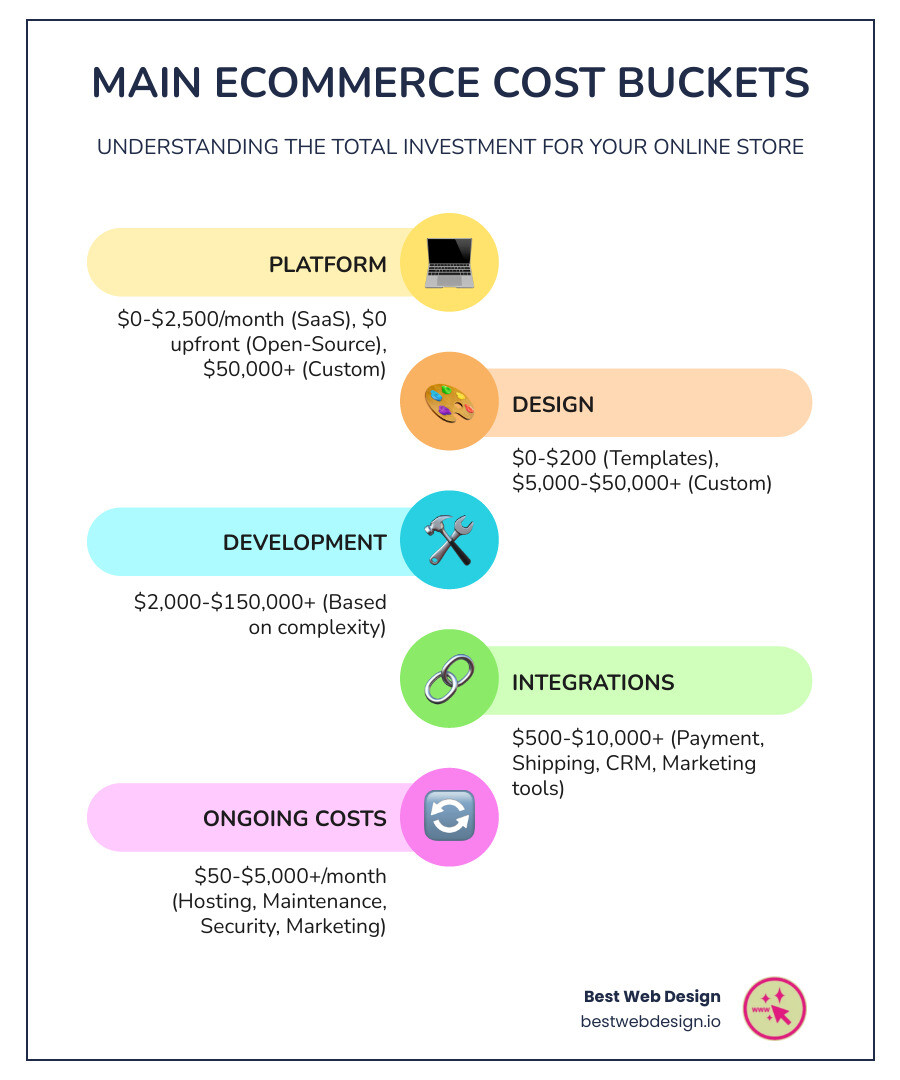
Choosing your development path is a critical decision that impacts your initial cost for ecommerce website development, ongoing expenses, and scalability. Let’s break down the main approaches:
| Development Approach | Typical Cost Range | Time Commitment | Customization Level | Ongoing Support | Ideal For |
|---|---|---|---|---|---|
| DIY Website Builders | $0 – $300/month (platform fees) + $0-$200 (themes) | Weeks | Low to Medium (template-driven) | Included in platform | Solopreneurs, startups, small product catalogs |
| Hiring Freelancers | $40 – $150/hour (US rates) or $500 – $3,000+ per project (design/copy) | Weeks to Months | Medium to High (project-dependent) | Project-based, variable | Specific tasks, small to medium projects with clear scope |
| Partnering with an Agency | $100 – $250+/hour (US rates) or $5,000 – $150,000+ per project | Months | High to Fully Custom | Comprehensive, retainer-based | Medium to large businesses, complex projects, long-term growth |
This table shows your budget is about the initial build, long-term commitment, and desired level of control.
SaaS vs. Open-Source vs. Custom-Built
Your store’s foundation dictates its cost and flexibility. There are three primary platform types:
-
SaaS Platforms (Software as a Service): Hosted, all-in-one solutions like Shopify, Wix eCommerce, and BigCommerce. They are easy to set up with predictable monthly fees (e.g., Shopify Basic at $29/month, Wix eCommerce from $27/month) that include hosting and security. The trade-off is limited customization and potential transaction fees (2.4%–3.5% on Shopify). This path offers a lower upfront cost and is ideal for prioritizing speed and ease of use.
-
Open-Source Solutions: Platforms like WooCommerce (for WordPress) offer free software but require technical expertise. You get maximum flexibility but must manage your own web hosting ($5–$250+/month), security (SSL certificate $0–$200/year), and maintenance. While there are over 58,000 free WordPress plugins, premium features often require paid plugins ($500+) or custom development. This approach has higher upfront development costs but lower ongoing platform fees.
-
Custom-Built Platforms: Developing a site from scratch offers unparalleled flexibility and unique functionality, perfect for complex business models. However, it carries the highest initial investment (starting from $50,000) and longest development time. It requires a dedicated team for the build and ongoing maintenance. This is best for large enterprises with significant budgets and complex needs.
DIY vs. Hiring Freelancers vs. Partnering with an Agency
The people building your site are a major cost factor.
-
DIY Website Builders: Ideal for solopreneurs on a tight budget, platforms like Wix and Shopify offer user-friendly interfaces. Costs are minimal (from $29/month plus a theme), but it requires a significant time investment from you (40-80 hours for a basic site). While cheap, remember your time is also a cost.
-
Hiring Freelancers: A cost-effective solution for specific tasks like design or copywriting. US hourly rates typically range from $40 – $150. This offers flexibility and specialized skills but requires you to manage the project and vet individuals, which can be time-consuming.
-
Partnering with an Agency: For comprehensive projects or long-term growth, an agency provides a full suite of services. Agency projects can range from $25,000 to $250,000+. At Best Web Design, we provide data-driven, conversion-focused digital products that drive growth. This approach offers specialized expertise, project management, and quality assurance. Learn more about our process. It’s a higher initial investment but pays off in quality and long-term success.
A Detailed Breakdown of the Cost for Ecommerce Website Development
Let’s explore what you can expect to pay, categorizing costs by the scale of your ecommerce ambitions.
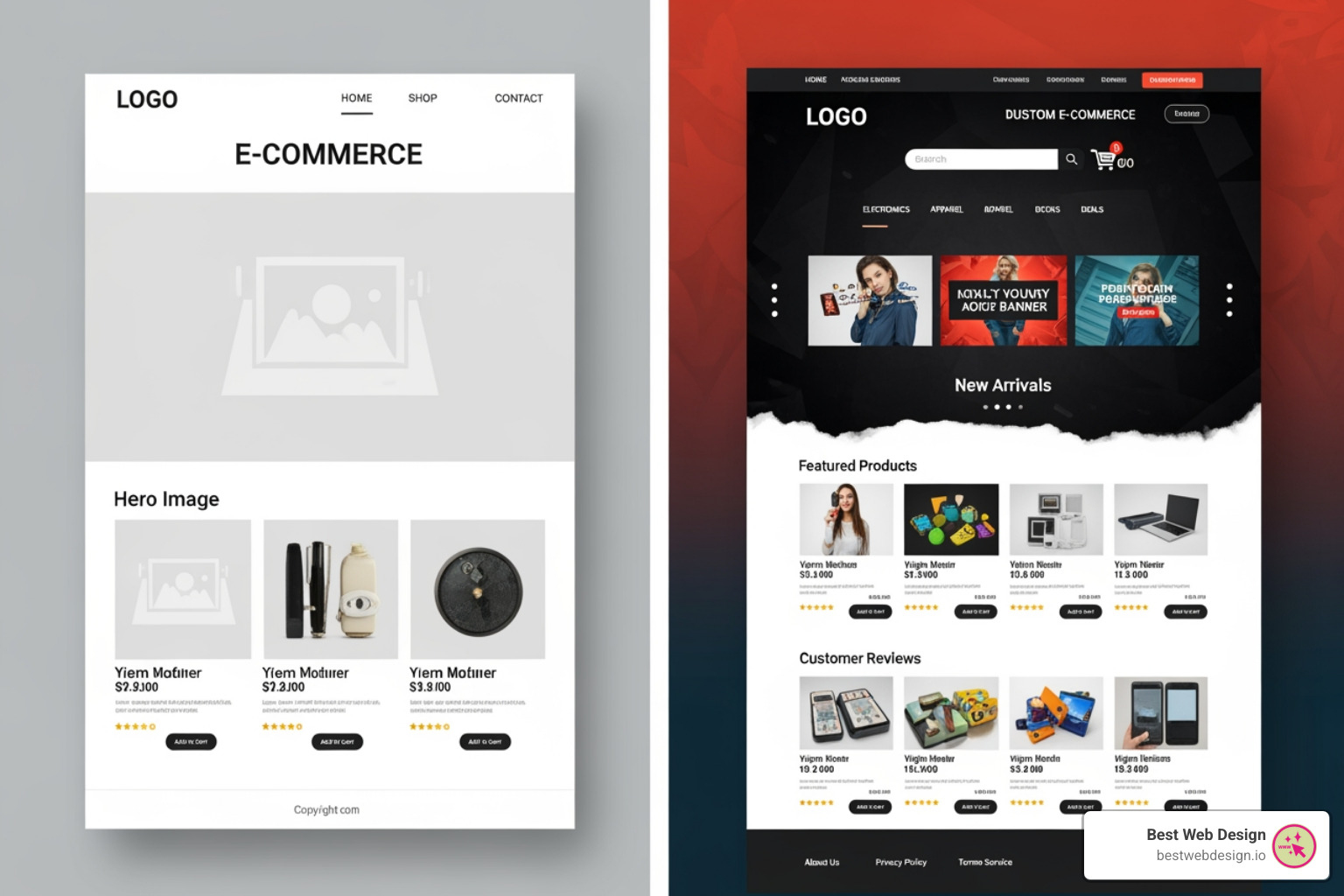
The range of cost for ecommerce website development is vast, as your business size and required features are the primary cost drivers.
Basic Store (Startup/Solopreneur): $1,000 – $10,000
This is the entry point for testing a product idea or a small business with a limited catalog.
- Platform: SaaS solutions like Shopify Basic ($29/month) or a WooCommerce setup on shared hosting ($2.50-$5/month).
- Design: Prebuilt themes (free to $200) with minor customization ($200-$1,500).
- Products: Up to 100 products, with data entry usually done by the owner.
- Features: Standard payment gateways (Stripe, PayPal), basic shipping options, and essential pages (Home, About, Contact, etc.).
- Initial Development: A small store (1-99 products) averages $1,000 – $5,000 for theme setup and configuration.
- Ongoing Costs: Platform subscription, domain ($10-$30/year), and minimal maintenance ($500-$1,000/year).
Medium Store (Growing Business): $10,000 – $50,000
For established businesses looking to expand their online presence and handle more sales.
- Platform: Shopify, BigCommerce, or a well-configured WooCommerce site ($50-$300/month).
- Design: Customized theme or a simple custom design ($750-$15,000). Branding may cost $4,500-$15,000 annually.
- Products: 100-1,000 products, possibly with complex variations.
- Functionality: Advanced search, CRM and email marketing integrations, and a CMS for content. Premium plugins can add up to $2,000 for customization.
- Initial Development: A medium store (100-499 products) averages $5,000 – $10,000 for custom coding and integration work.
- Ongoing Costs: Platform fees, VPS hosting ($20-$100/month), maintenance ($1,000-$2,000/year), security ($500-$6,000/year), and marketing ($500-$5,000/month).
Complex/Enterprise Store (Large Business): $50,000 – $150,000+
For large businesses requiring extensive customization, high performance, and robust integrations.
- Platform: Shopify Plus ($2,300+/month), Magento Commerce, or a fully custom-built solution.
- Design: Fully custom UX/UI design based on user research, wireframing, and prototyping ($15,000-$50,000+).
- Products: 1,000+ products, with configurable options, bundles, or subscriptions.
- Functionality: Custom product configurators, AR features, advanced API integrations (ERP, PIM), multi-regional support, and custom fraud detection ($20,000-$60,000).
- Initial Development: A large store (500+ products) starts at $10,000 – $50,000+ and is handled by an experienced agency over 4-9+ months.
- Ongoing Costs: High-tier platform fees, dedicated hosting, extensive maintenance (15-20% of initial cost per year), advanced security ($6,000+/year), and large marketing budgets ($10,000+/month).
The Anatomy of Your Bill: Key Cost Drivers
Understanding the specific elements that contribute to your cost for ecommerce website development is crucial for budgeting. Since you have only 50 milliseconds to convince visitors your site is trustworthy, investing in functionality, scalability, and user experience is paramount.
Design, Branding, and Responsiveness
Design heavily influences user experience and conversion rates, with 94% of first impressions relating to your site’s design.
- Template vs. Custom Design: Prebuilt themes (free to $200) are economical but limit uniqueness. Customizing a theme can cost $200-$1,500, while a fully custom design for a unique brand experience ranges from $750 to $15,000+, and can exceed $50,000 for enterprise sites.
- Branding: A cohesive branding package (logo, colors, typography) can cost small to medium businesses $4,500 to $15,000 per year.
- Responsive Design: With 76% of US adults using smartphones to shop online, your site must function flawlessly on all devices. Ensuring perfect responsiveness for complex layouts can add $3,000-$25,000 to the cost.
- User Experience (UX): Good UX (intuitive navigation, fast load times, clear CTAs) is vital for building trust. This is embedded in the overall design and development cost, with custom animations or interactive elements increasing the budget.
The impact of features and integrations on the cost for ecommerce website development
Each service your store connects with adds complexity and cost.
- Payment Gateways: Essential for sales, providers charge transaction fees. Shopify Payments fees are 2.4%–3.5%, while PayPal Checkout is 3.49% + a fixed fee, and Stripe Standard is 2.9% + $0.30. Setup can cost $500-$2,000.
- Shipping Integrations: Connecting with carriers like USPS or FedEx for real-time rates involves setup costs or recurring fees.
- Marketing & CRM: Integrating with email platforms (Mailchimp, Klaviyo) can cost $500-$3,000 for setup, while CRM integration can be $1,000-$4,000.
- Custom Plugins: When off-the-shelf solutions aren’t enough, custom functionality can range from $1,000 to $15,000+, depending on complexity.
Product Catalog and Scalability
The volume and complexity of your products significantly influence costs.
- Number of Products: A store with 500+ products requires more robust database architecture than one with under 100.
- Product Variations: Multiple sizes, colors, or materials add complexity to the UI and data management.
- Custom Configurators: Allowing customers to design their own products requires significant custom development, often costing $1,000-$15,000 for the feature alone.
- Scalability: Building with future growth in mind is crucial. A scalable database and architecture can be a significant upfront investment ($20,000-$25,000 for custom solutions) but saves money on re-development later.
Beyond the Launch: Ongoing & Hidden Expenses
Launching your site is just the beginning. Many businesses overlook post-launch expenses, which significantly impact the total cost for ecommerce website development and ownership.
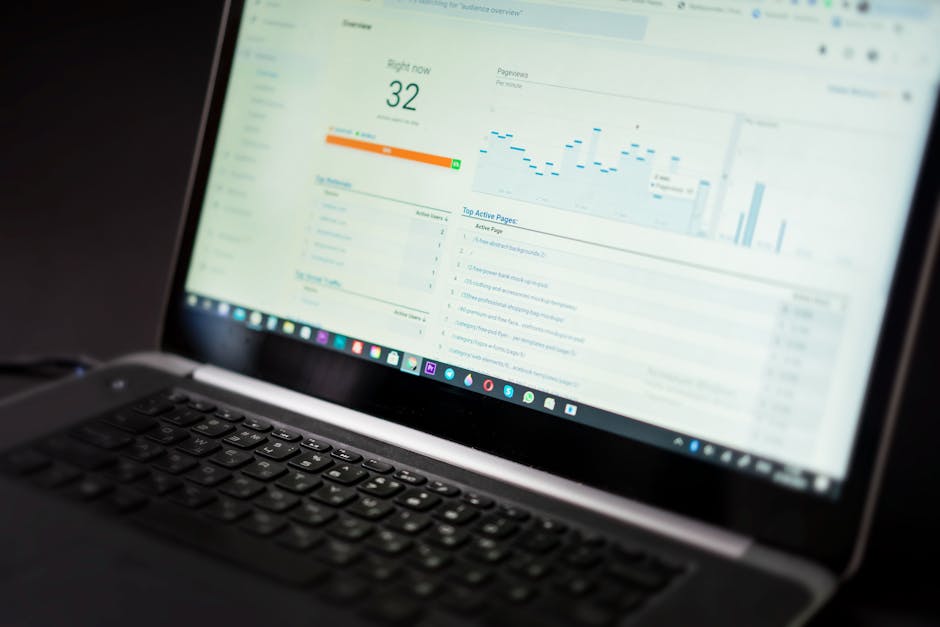
These ongoing costs are vital for performance, security, and growth. Ignoring them can lead to downtime, security breaches, and lost sales.
The long-term cost for ecommerce website development and maintenance
- Website Hosting: This is your site’s home on the internet. Costs range from shared hosting ($2.50-$5/month) to VPS ($20-$100/month) or dedicated servers ($100+/month). SaaS platforms like Shopify include hosting in their monthly fees ($80-$730/month for higher plans).
- Domain Name Renewal: Your website’s address typically renews for $10-$30 annually.
- SSL Certificate: Essential for security, many hosts provide free SSLs. Otherwise, they cost up to $200 annually.
- Security & PCI Compliance: Protecting your site from hackers is crucial. Security software can cost $500 to $6,000+ per year. If you’re self-hosted, achieving PCI compliance can cost $1,000-$5,000 for setup.
- Software Updates: Regular maintenance to keep your platform and plugins updated can cost 15-20% of your initial development cost per year.
Often Overlooked Costs
- Data Backups: Essential for protecting your site data.
- Content Creation: High-quality copy and blog posts are critical. Freelance copywriters can charge $50-$150/hour.
- Product Photography: Professional images are crucial for online sales and building trust.
- Digital Marketing Budget: People need to find your site. Budget for SEO ($500-$12,000/month), PPC ($500-$10,000/month), social media, and email marketing. For more tips, read our Blog.
- Technical Support: You’ll eventually need technical help. This may be included in an agency retainer or paid for as needed.
Frequently Asked Questions about Ecommerce Development Costs
Here are answers to some of the most common questions about budgeting for your online store.
What is the cheapest way to build an ecommerce website?
The most cost-effective way to build an ecommerce site involves:
- DIY Builders: Use platforms like Wix eCommerce (from $27/month) or Shopify’s Basic plan ($29/month) which bundle hosting and security.
- Free Themes: Start with free themes from the Shopify Themes store or for open-source platforms like WooCommerce.
- MVP Approach: Launch with a Minimum Viable Product (MVP) containing only core features. This can reduce the initial cost for ecommerce website development to the $8,000-$20,000 range, with more features added later.
- Low-Inventory Models: Consider dropshipping or print-on-demand to minimize upfront inventory costs.
How long does it take to build an ecommerce store?
The timeline varies by complexity:
- Basic Sites (4-6 weeks): A simple, template-based store on a SaaS platform.
- Medium Sites (2-4 months): A store with a customized theme and a few key integrations.
- Complex Sites (4-9+ months): Custom-built platforms or sites with extensive unique functionality.
Timelines are influenced by project scope, the number of products, and the speed of client feedback.
How can I get an accurate quote for my project?
To get an accurate quote, you need to provide clarity:
- Detailed Project Brief: Outline your business goals, target audience, and brand identity.
- Clear Requirements: List all desired features, functionalities, and integrations, categorizing them as “must-have” vs. “nice-to-have.”
- Design Mockups: Share any wireframes or visual ideas you have.
- Consult a Professional: The best way to get a precise estimate is to discuss your vision with an experienced team. You can request a custom quote from us to get a clear understanding of the investment required.
Conclusion: Investing in Your Digital Future
The cost for ecommerce website development is a multifaceted investment, not just an expense. It ranges from $1,000 for a basic store to over $150,000 for a complex enterprise solution, reflecting your project’s ambition and functionality. This cost covers platform choice, design, integrations, and ongoing maintenance.
Your website is your most powerful sales tool. In a rapidly growing ecommerce market, a well-executed online store is essential. Cutting corners on responsive design, security, or user experience leads to lost sales and a lower return on investment.
At Best Web Design, we understand that every dollar counts. We specialize in delivering data-driven, conversion-focused digital products that drive user retention and business growth. We build online stores that are strategically designed to convert visitors into loyal customers.
Ready to build an online store that generates significant ROI? Let us help you steer the complexities and build a thriving digital future. Explore our conversion-focused Offerings to see how we can transform your ecommerce vision into reality.